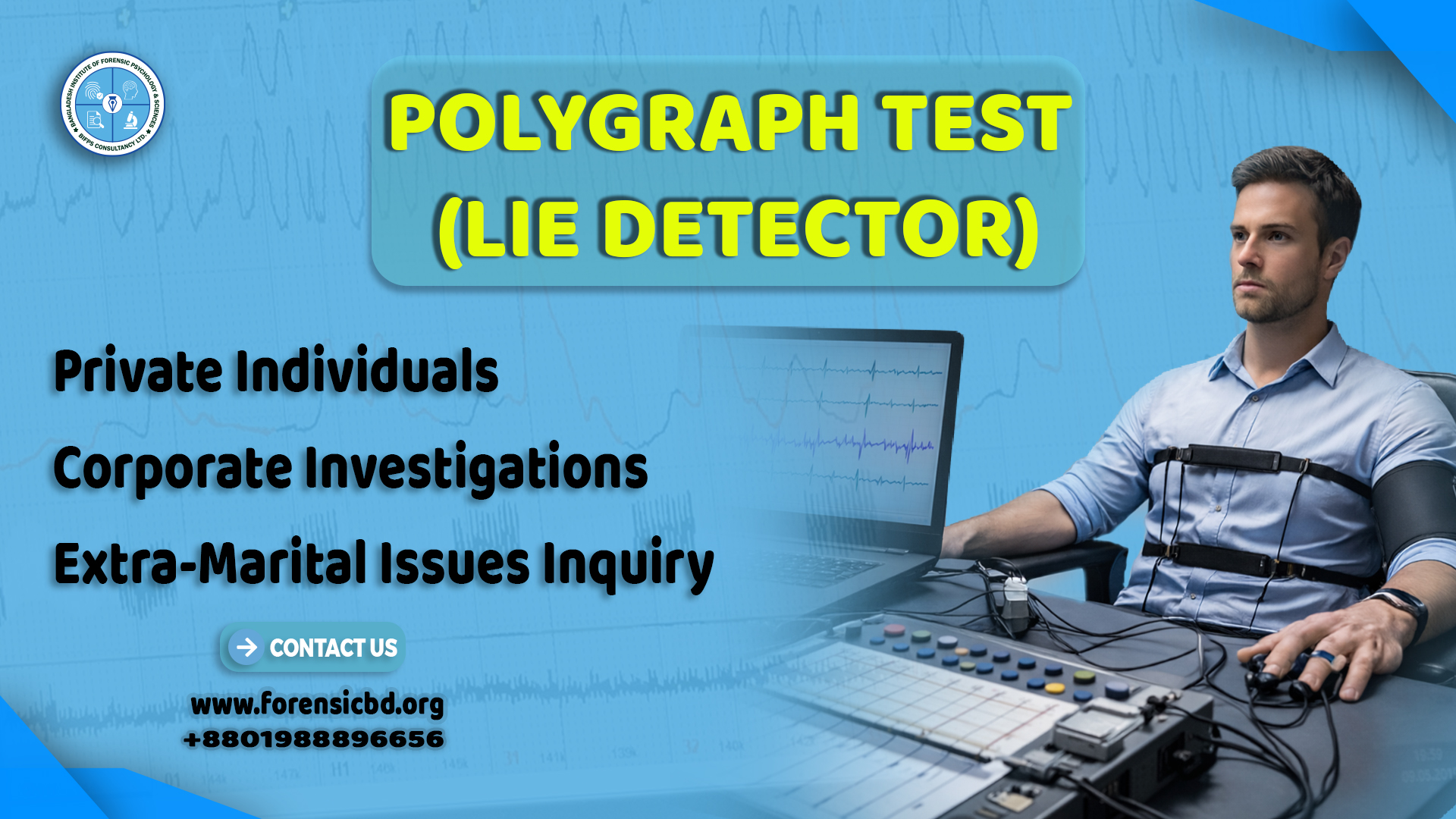
Lie Detector (Polygraph)Test for Cheating
Polygraph
Test (Lie Detector Test)
A
Scientific Forensic Method for Truth Verification
A Polygraph Test, commonly known as a Lie
Detector Test, is a professional forensic assessment method used to assist in
truth verification through physiological and psychological analysis.
BIFPS Consultancy Ltd. (ForensicBD™) was the first organisation to
professionally introduce this service in Bangladesh.
As the first specialised polygraph
examination institution in Bangladesh, we provide truth-verification assistance
using internationally recognised forensic methodologies, psychological
assessment, behavioural analysis, and modern computerised polygraph systems.
What is a Polygraph Test?
A polygraph test is a scientific assessment
process in which involuntary physiological responses are measured and analysed
while a person answers specific questions.
The examination is conducted by trained forensic professionals and certified
polygraph examiners.
The primary objective of the examination is
to identify physical and psychological response patterns that may indicate
stress, deception, concealment of information, or truthfulness.
How Does a Polygraph Test Work?
During the examination, a computerised
polygraph instrument simultaneously records multiple physiological changes,
including:
- Heart Rate
- Blood Pressure
- Respiration Pattern
- Skin Conductance / Electrodermal Activity
- Movement Detection
- Pupillary & Behavioral Responses
When a person experiences deception or
psychological stress, the autonomic nervous system may produce involuntary
physiological reactions.
These responses are analyzed by trained polygraph examiners through
standardized scoring systems, computerized chart analysis, and behavioral
assessment techniques.
Our Modern Polygraph System
We use advanced computerised polygraph
examination systems, including:
- CPS Elite System with Electronic Pneumos
- CPS Plethysmograph
- CPS Elite Complete Movement Sensor Package, including:
- Masseter Headset
- Arm Sensors
- Feet Sensors
- Seat Sensor
These advanced technologies help monitor
physiological responses more accurately and reduce movement-based
countermeasures during examinations.
Stages of Our Polygraph Examination
Process
1. Case Assessment & Pre-Test
Interview
Before the examination, the examinee
undergoes a detailed interview process where case-related information, behavioural
indicators, and psychological background are assessed.
This stage may include:
- Psychological Profiling
- Behavioural Observation
- Body Language Analysis
- Question Structuring & Validation
The examinee is informed in detail about
the examination procedures, limitations, and consent-related matters.
2. Polygraph Examination Phase
Scientifically structured questions are
prepared according to the context of the case.
During questioning, the computerised polygraph system simultaneously records
physiological responses.
3. Data Analysis & Interpretation
Collected physiological data are analysed
through:
- Computerised Polygraph Charts
- Behavioural Indicators
- Standardised Scoring Systems
- Comparative Physiological Analysis
The examiner then professionally interprets
and evaluates the findings.
4. Final Professional Opinion
After the analytical process is completed,
the examiner provides a neutral professional opinion based on the examination
findings.
Results may generally be categorised as:
- Truthfulness Indicative
- Deception Indicative
- Inconclusive
- Incomplete Examination
Areas of Use of Polygraph Examination
Polygraph examinations are used in many
countries for investigative and truth-verification purposes, including:
- Suspicion Verification
- Marital and Relationship Disputes
- Infidelity Investigations
- Family Dispute Resolution
- Corporate Fraud Investigations
- Employee Screening
- Workplace Misconduct Investigations
- Criminal Investigations
- Legal & Investigative Support Assessments
- Internal Fraud Investigations
- Pre-Employment Screening
- Theft or Betrayal Related Matters
Is Polygraph Evidence Admissible in
Court?
Polygraph testing is still relatively new
in Bangladesh, and its formal use in Bangladeshi courts has not yet been
officially established. However, in neighbouring India and many other
countries, polygraph examinations are used as investigative support tools and
interrogation-assistance techniques.
Countries including the United States,
Mexico, Russia, Israel, South Africa, Ukraine, Japan, and India use polygraph
examinations in various investigative and forensic contexts.
In India, Polygraph, Layered Voice Analysis
(LVA), and Brain Mapping are regularly used by various Forensic Science
Departments, Forensic Science Laboratories (FSL), and investigative agencies.
Although polygraph reports are generally
not considered standalone or conclusive legal evidence, they are widely used as
supportive investigative tools to assist in investigations, behavioral
assessments, and truth-verification processes.
Polygraph findings should always be
evaluated alongside other evidence, investigations, and forensic analyses.
Personal & Corporate Use in
Bangladesh
Globally, polygraph examinations are used
in corporate investigations, internal fraud investigations, pre-employment
screening, marital disputes, theft-related matters, and behavioral
investigations.
In Bangladesh, there is currently no
specific legal prohibition against conducting such examinations when performed
professionally, ethically, and with informed consent.
Use of Additional Forensic Technologies
In addition to Polygraph Examination, we
also advocate and work with modern forensic and behavioural assessment
technologies such as:
- Layered Voice Analysis (LVA)
- Brain Mapping
- Psychological Profiling
- Behavioural Observation
- Investigative Interviewing
Over the past several years, we have
provided technical support and professional consultation on these subjects to
various Government Agencies and Law Enforcement Organizations.
Use Beyond Law Enforcement Agencies
Polygraph examinations are not limited to
CID or DB only. Around the world, private investigation agencies, corporate
security units, and forensic consultancy organisations also use polygraph
examinations.
Important Scientific & Legal
Limitations
Polygraph testing is a supportive forensic
assessment method. For sensitive matters, additional support may be required
through:
- Digital Forensics
- Cyber Investigation
- Behavioural Investigation
- Documentary Evidence
- Witness Statements
- Other forensic analyses
Voluntary Participation Policy
Participation in any polygraph examination
must be completely voluntary. We take the signature of participants on a 300
taka government stamp that he/ she is willing and self-voluntary participants
in the polygraph. No examination is conducted through coercion, pressure, or
unlawful means.
Prior to examination, informed consent is
obtained regarding:
- Interview Procedures
- Psychological Profiling
- Polygraph Examination
- Recording & Documentation
Confidentiality Policy
All examination records, reports, interview
materials, and analytical information are maintained confidentially according
to professional forensic and ethical standards.
The institution’s internal procedures,
scoring systems, and forensic frameworks are considered intellectual property.
Recording & Documentation Policy
For professional, security, and
documentation purposes, video, audio, behavioural, and analytical recordings
may be conducted during the examination process.
These materials remain institutional
property and may be securely preserved for professional and legal documentation
purposes.
Health & Physical Condition
Requirements
Examinees must disclose important
conditions, including:
- Neurological Disorders
- Mental Health Conditions
- Heart Disease or Physical Complications
- Medication Usage
- Drug or Alcohol Consumption
Failure to disclose such information may
affect examination accuracy.
Countermeasure & Non-Cooperation
Policy
Attempts to manipulate physiological
responses, conceal information, or obstruct the examination process may result
in:
- Cancellation of the Examination
- Classification as Incomplete Examination
- Refusal of Re-Examination
Polygraph Examination Fee
BDT 50,000 only
The fee includes:
- Psychological Profiling
- Body Language Analysis
- Pre-Test Interview
- Polygraph Examination
- Data Analysis
- Final Professional Opinion Report
Payment Policy
- Full payment must be completed before the examination
- Fees are completely non-refundable
Who Conducts the Polygraph Examination?
Polygraph examinations are conducted by
trained and certified professionals with expertise in:
- Forensic Psychology
- Human Behavioral Analysis
- Investigative Interviewing
- Scientific Lie Detection
- Psychological Assessment
To ensure accurate results and professional
standards, examinations should be conducted by internationally trained and
experienced Polygraph Examiners, which is provided in Bangladesh by BIFPS
Consultancy Ltd. (ForensicBD).
Lead Polygraph Examiner
Md Meraz Hossain
- PhD Scholar in Forensic Psychology, National Forensic Sciences
University, India
- MSc in Clinical & Counselling Psychology, Jagannath
University, Dhaka
- BSc in Psychology, Jagannath University
- PGT in Psychotherapy, BSMMU, Bangladesh
- Addiction Professional (DNC), Dhaka
- Certified NLP Trainer & Life Coach
- CBT Trainer & Corporate Trainer
- Graphologist (Handwriting Analysis Expert)
- Forensic Document Examiner
- Body Language Analyst
- Lie Detection (Polygraph) Examiner
- Private Investigator
- SEAH Investigator
- Former Guest Lecturer, Govt. Titumir College, Dhaka
- Trainer for Military, Police & Intelligence Agencies,
Bangladesh
- Managing Director, Bangladesh Institute of Forensic Psychology
& Sciences; BIFPS Consultancy Ltd.
He works in the fields of forensic
behavioral analysis, deception detection, psychological assessment,
investigative interviewing, and scientific truth-verification methodologies.
Through multidisciplinary forensic approaches, he provides investigative, behavioral
assessment, and forensic support services.
Ethics & Professional Commitment
All examinations are conducted in
accordance with professional forensic ethics, institutional protocols, and
applicable laws.
BIFPS Consultancy Ltd. (ForensicBD)
reserves the right to refuse or terminate any examination under any
circumstances.
Final Disclaimer
Polygraph testing is a scientific,
analytical, and supportive forensic assessment method designed to assist
truth-verification processes through physiological and psychological analysis.
However, polygraph examination should not
be considered the sole or absolute determinant of truth, deception, guilt, or
innocence. In many situations, additional supporting evidence and forensic
analyses may also play an important role.